


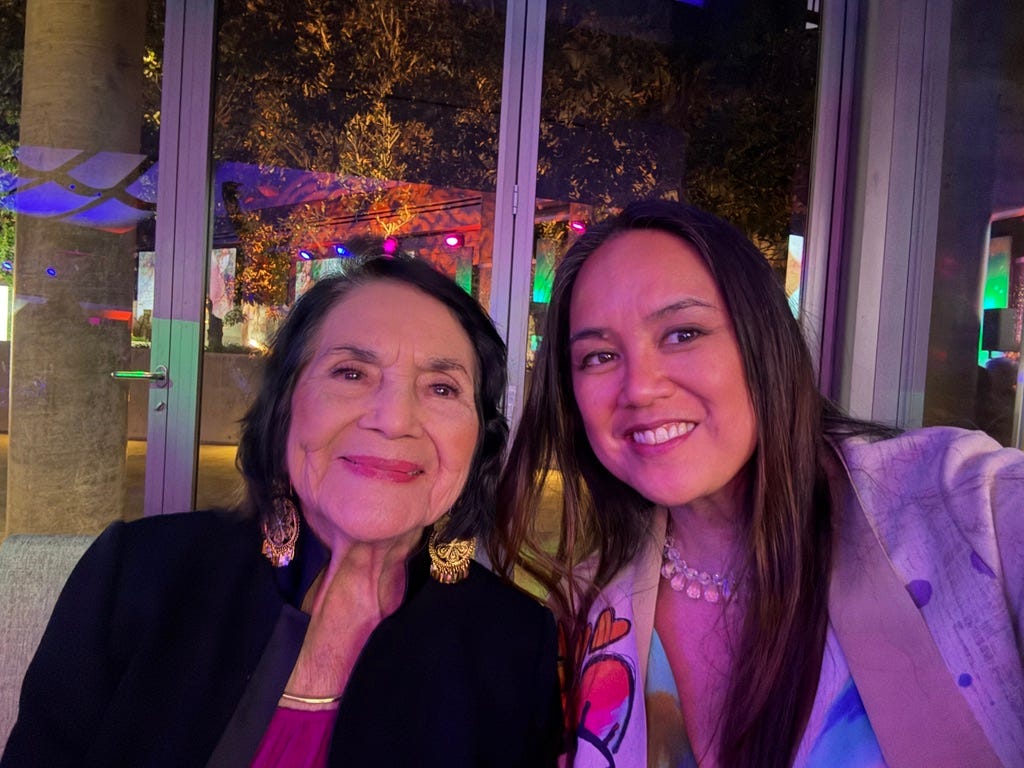
There are moments when history makes a cataclysmic shift because someone made the heart-wrenching decision to say something out loud.
At nearly 96 years old, Dolores Huerta—one of the architects of the modern labor movement—has publicly shared reflections on her experiences within the movement she helped build alongside Cesar Chavez.
In a recent investigation by The New York Times, multiple women came forward with accounts of abuse, including allegations involving minors, placing her revelations within a larger and deeply alarming pattern. And almost immediately, the conversation fractured. Not around her. Around him.
He can’t defend himself. Why now? It was a different time.
These responses aren’t new. They reflect a long-standing cultural reflex: when a woman speaks, we often look past her to the man, his reputation, his contributions.
Many are conflicted about protecting legacy rather than expanding truth. We know Dolores Huerta as the co-founder of the United Farm Workers. We know her voice: “Sí, se puede.”
But what we often forget, or were never taught, is how many women built these movements while navigating environments that did not fully protect them. Women who organized. Negotiated. Led. And endured in the face of stark imbalances relating to gender and power.
American media storytelling loves a singular hero. It’s cleaner. Easier. Marketable. But movements are messy. They are built by coalitions, contradictions, and people who are capable of both incredible courage and real harm.
Holding that complexity is uncomfortable, but if we fall into the trap of flattening history into hero worship, we risk erasing people, and those people are often women who carried this burden, this weight.
Yes, it was a different time. And that context matters. But context is not absolution. Saying “it was a different time” should deepen our insight of that time without silencing the people who lived through it.
We should be asking: What did it cost women to participate in these movements? What did they have to navigate just to lead?
There’s a reason these stories surface decades later. Because silence has rarely seemed like a choice for so many women. What’s different now is not the harm; it’s the post-#MeToo world we live in and the possibility of being heard.
When the accounts include individuals who were minors, the conversation moves beyond the already difficult terrain of gender and power into something that demands we set aside our discomfort entirely.
These are serious questions of child abuse that can not be ignored. To progress as a society, when we talk about “context,” we also have to be honest about what that context enabled and who it failed to protect: young women and girls.
To acknowledge harm is not to erase legacy but to become aware of the fuller story — one that recognizes the hidden heroism of women facing a struggle on two fronts at once.
We can honor the contributions of Cesar Chavez to labor rights. And we can listen to what Dolores Huerta has shared about her experience. Both can exist. Two things can be true at the same time. In fact, they must. Because if we only preserve the parts of history that make us comfortable, we curate mythology and fail at protecting history at all.
It’s past time to elevate the work women have done in the face of gender inequities that have too often left us unprotected, unrecognized, and unheard. These are the hidden costs of the struggle, and they reveal something essential: history isn’t sacred. But the truth is.
Wasn't she married to his brother? Why is no one questioning this from an about to be 96 year old? Don't get me wrong, she's one of my heroes.